NewAthena SCIENCE CONFERENCE
Novinky
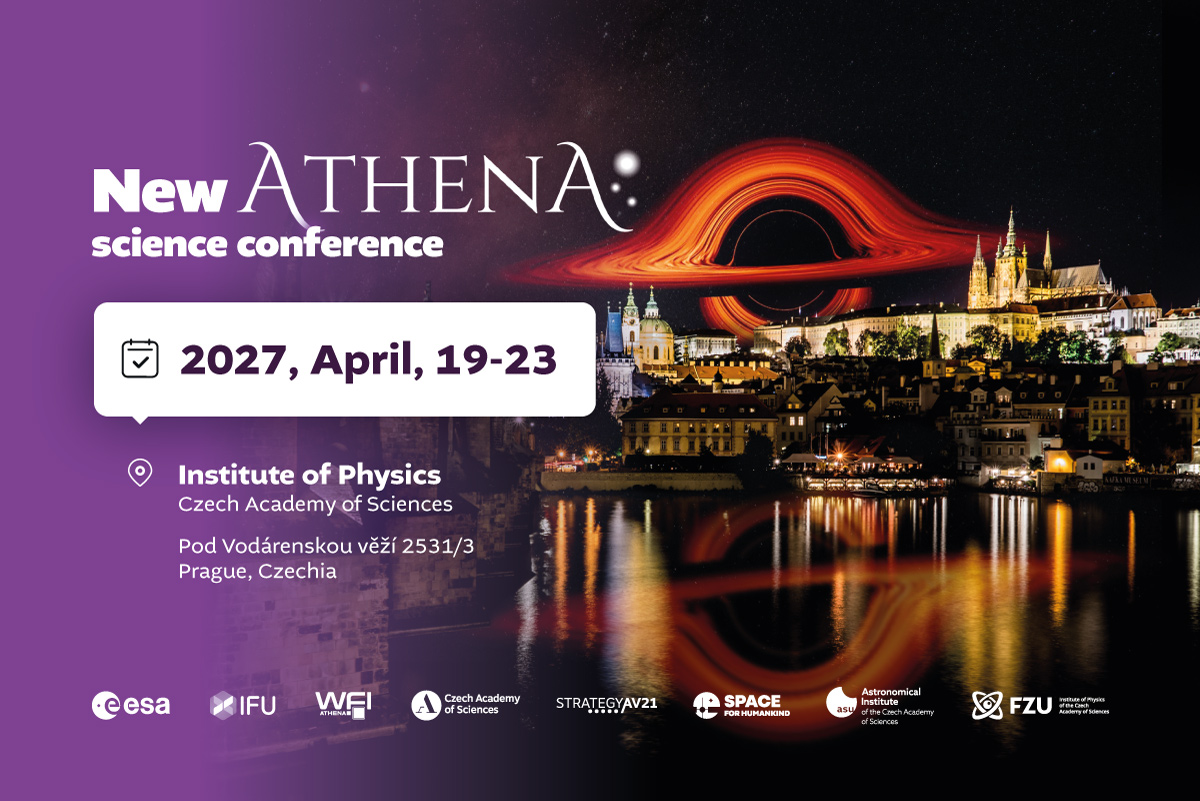
The 4th conference on “Exploring the Hot and Energetic Universe” will take place in Prague, Czech Republic, from 19–23 April 2027.
- The abstract submission is now open, with the deadline of 19 November 2026. https://indico.fzu.cz/event/352/abstracts/
To submit an abstract, you need to create an account in the FZU Indico system. Please read a Step-by-step guide for the abstract submission procedure.
Topics
Scope of the conference
As NewAthena progresses towards mission adoption, the meeting will bring together the international high-energy astrophysics community to discuss the mission’s scientific goals, future observing programmes, and synergies with current and upcoming facilities. The conference will provide a forum for presenting recent scientific results, strengthening collaborations, and maximising the scientific return of ESA’s next flagship X-ray observatory.
The scientific programme will cover a broad range of topics in high-energy astrophysics, including galaxy groups and clusters, supermassive black holes, compact objects, transient phenomena, multi-messenger astrophysics, and the interplay between high-energy observations and other major astronomical facilities.
The NewAthena mission
The NewAthena mission
NewAthena (New Advanced Telescope for High-ENergy Astrophysics) is ESA’s next flagship X-ray observatory, currently planned for launch in 2037. The mission is designed to address some of the most fundamental questions in modern astrophysics, including the formation and evolution of large-scale cosmic structures, the growth and impact of supermassive black holes, and the behaviour of matter under extreme physical conditions.
The observatory will combine an unprecedented X-ray collecting area with powerful imaging and high-resolution spectroscopic capabilities provided by its two scientific instruments: the Wide Field Imager (WFI) and the X-ray Integral Field Unit (X-IFU). Together, these instruments will enable transformational studies of the hot and energetic Universe across a wide range of astrophysical environments.
Further information about the mission, its scientific objectives, and current development status can be found on the official NewAthena website: https://www.the-athena-x-ray-observatory.eu/en
Invited speakers

James Aird
James Aird is a professor at the University of Edinburgh's Institute for Astronomy. He studies populations of Active Galactic Nuclei, their evolution, and their co-evolution with galaxies using large-scale X-ray surveys combined with multiwavelength imaging and spectroscopy. He is a member of the NewAthena Science Study Team with particular interests in using NewAthena to search for the earliest supermassive black holes and the wider potential of the next-generation X-ray surveys that NewAthena will perform.
Title: Tracing black-hole growth and its connection to galaxy evolution across cosmic time
Didier Barret
Didier Barret is a high-energy astrophysicist working at the Institute of Research in Astrophysics and Planetology of Toulouse. His scientific research is centered on the analysis and interpretation of X-ray data collected by space observatories from accreting compact objects, mainly X-ray binaries containing black holes and neutron stars. He is developing new analysis methods for high resolution X-ray spectroscopy. He is currently the Principal Investigator of the X-ray Integral Field Unit (X-IFU) to fly on board the NewAthena X-ray Observatory of the European Space Agency.
Title: X-IFU science capabilities and instrument overview
Ricarda Beckmann
Ricarda Beckmann is a computational astrophysicist who works at the University of Edinburgh. She studies the coevolution of massive black holes and galaxies across cosmic time using cosmological simulations. Her particular expertise focuses on understanding the impact of black hole dynamics and spin on the evolving population of black holes.

Veronica Biffi
Veronica Biffi is a staff researcher at the INAF – Astronomical Observatory of Trieste, Italy. Her research lies at the intersection of computational astrophysics and observational X-ray astronomy, focusing on galaxy clusters. She studies the thermodynamics and chemical enrichment of the intracluster medium using cosmological hydrodynamical simulations. Specializing in bridging simulations with high-energy observations, she has developed dedicated software tools to convert simulated data into realistic synthetic X-ray observations for current and future space missions.
Title: Chemical enrichment in the intra-cluster medium from cosmological simulations
Esra Bulbul
Assoc. Prof. (P.D.) Esra Bulbul is a group leader at the Max Planck Institute for Extraterrestrial Physics (MPE) and Ludwig Maximilian University, where she leads the eROSITA Clusters and Cosmology Group. Her research focuses on galaxy clusters and cosmology, using multi-wavelength surveys to study the formation and evolution of large-scale structure in the Universe and to constrain baryonic physics and cosmological models. She is particularly interested in using galaxy clusters to understand the growth of cosmic structures and the nature of dark matter and dark energy. She chairs the NewAthena Cosmology and Fundamental Physics Working Group (SWG6).
Title: From Dark Energy to Cosmic Filaments: Baryons Across the Universe
Camille Diez
Camille Diez is a CNES Research Fellow at IRAP in Toulouse in France. Her research interests focus on X-ray spectroscopy of accreting neutron stars in binary systems and their local environment using in particular observations from XRISM, NuSTAR, XMM-Newton and SVOM. She is an active member of the NewAthena scientific community and currently investigates how NewAthena will revolutionise our understanding of wind accretion mechanisms onto compact objects.
Title: Stellar winds and wind accretion in neutron-star X-ray binaries
Michal Dovčiak
Michal Dovčiak is a senior researcher at the Astronomical Institute of the Czech Academy of Sciences in Prague, where he leads the Relativistic Astrophysics group. His research focuses on how strong gravity shapes the X-ray spectra, variability and polarisation of radiation from the immediate surroundings of black holes, both in active galactic nuclei and in X-ray binaries. He developed the KY suite of relativistic models for fitting observational data and simulating observations for future missions. He co-chaired the Athena science panel on the close environments of supermassive black holes and has contributed to the science cases of many X-ray mission concepts. As a core member of the IXPE team and chair of its Topical Working Group on Accreting Stellar-Mass Black Holes, he shared in the 2024 Bruno Rossi Prize awarded to the mission team.
Title: Strong-gravity effects and X-ray polarimetry of accreting black holes
Javier García
Javier García is a Research Astrophysicist in the X-ray Astrophysics Laboratory at NASA’s Goddard Space Flight Center and a Visiting Researcher at Caltech. His research focuses on accretion physics around black holes and neutron stars, using X-ray reflection spectroscopy to probe the innermost regions of accretion disks, measure black hole spins, and constrain the geometry of the X-ray-emitting corona. He is the lead developer of the XILLVER, and co-developer of the RELXILL reflection models, and works on the atomic data and photoionization calculations used by these codes. He chairs the NewAthena Science Working Group 2 (“Galaxies and supermassive black holes”).
Title: X-ray reflection and accretion physics around black holes and neutron stars
Liyi Gu
Liyi Gu is a Scientist at the Space Research Organisation Netherlands (SRON), where he uses high-resolution X-ray spectroscopy to study outflows from active galactic nuclei and the hot atmospheres of galaxy clusters. He is responsible for the atomic data and plasma models in the SPEX spectral analysis code and serves as Principal Investigator for XMM-Newton’s Reflection Grating Spectrometer (RGS) and Chandra’s Low Energy Transmission Grating Spectrometer (LETGS).
Title: Decoding the X-ray Universe: Atomic Physics and Spectral Modeling for NewAthena
Matteo Guainazzi
Matteo Guainazzi is the Project Scientist of NewAthena at the European Space Research and Technology Center (ESTEC) of the European Space Agency (ESA). His scientific research focuses on the study of the innermost structure of Active Galactic Nuclei (AGN), and on AGN feedback.
Title: NewAthena mission status
Sebastien Guillot
Sebastien Guillot is a high-energy astrophysicist working at the Institute of Research in Astrophysics and Planetology of Toulouse. His research focuses on the study of neutron stars, at different wavelengths, but with a particular expertise on the X-ray range, to understand their interior, their evolution, and their emission mechanisms.
Title: Neutron-star radii and the dense-matter equation of state in the 2040s with NewAthena
Ekaterina Ilin
Ekaterina Ilin is a Research Group Leader at the Max Planck Institute for Solar System Research in Göttingen, Germany, where she studies the magnetic interactions between stars, brown dwarfs and planets. Her work uses multiwavelength observations from X-ray through optical to radio to understand the mechanisms underlying the influence of secondaries on their primaries in low mass object pairs, such as star-planet or brown-dwarf planet systems. She is leading the New Athena Special Issue chapter on Flares and Star-Planet Interactions.

Francois Mernier
Francois Mernier is an assistant astronomer at IRAP in Toulouse (France). His research focuses on hot atmospheres pervading clusters and groups of galaxies, particularly on their metal enrichment and kinematics as revealed through high-resolution X-ray spectroscopy. He is actively involved among the NewAthena science community, as co-chair of the Science Working Group 1 (“Large-scale structure of the Universe”), as well as member of the X-IFU consortium (scientific co-I, XSAT, and XCaT).

Marco Miceli
Marco Miceli is a Full Professor of Astrophysics at the University of Palermo, Italy. His research interests embrace different topics of high-energy astrophysics, with a particular focus on supernova remnants, cosmic rays, and shock physics. His work combines detailed spatial and spectral analysis of thermal and non-thermal X-ray emission with dedicated multi-D MHD simulations. He is currently the chair of the NewAthena SWG3 "Stars and their environments".
Title: Supernova remnants: shocks, ejecta and particle acceleration in X-rays
Giovanni Miniutti
Giovanni Miniutti is a senior researcher at the Centro de Astrobiología (CAB) in Madrid. His research interests revolve around accreting black holes, from Active Galactic Nuclei to Tidal Disruption Events, with a focus on X-ray spectroscopy and variability studies. He serves as co-chair of the NewAthena SWG2 “Galaxies and Supermassive Black Holes” and as Science Co-Investigator of the X-ray Integral Field Unit (X-IFU) on board NewAthena.
Title: QPEs, TDEs and extreme X-ray variability in galactic nuclei
Jon Miller
Jon studies black holes across the mass scale, and neutron stars. He currently serves as the Chair of the XRISM User's Group, is a NASA representative on the X-IFU Science Advisory Team, and the Chair-elect of the AAS/HEAD division. Jon races cyclocross in the fall and winter.

Luigi Piro
Luigi Piro is a high-energy astrophysicist working at Istituto di Astrofisica e Planetologia Spaziali, INAF-Rome, as Director of Research. His main research topics are explosive transients, mainly Gamma-Ray Burst, Fast Radio Burst, AGN, with emphasis on multiwavelength and multimessenger observations. He has initiated the development of high-resolution X-ray spectroscopy microcalorimeters in Italy, and he is currently the Co-Principal Investigator of NewAthena X-IFU and PI of the NewAthena Italian Consortium.

Ioanna Psaradaki
Ioanna Psaradaki is a Research Fellow at ESA/ESTEC, where she focuses on investigating the properties of cosmic dust in our Galaxy, and its role near active galactic nuclei. Her research bridges experimental and observational astrophysics, combining laboratory studies of interstellar dust analogues and gas-phase species with high-resolution X-ray observations from XMM-Newton, Chandra, and XRISM. She is currently exploring how NewAthena can significantly advance our understanding of cosmic dust.
Title: Exploring the chemistry of cosmic dust: an X-ray overview
Andy Ptak
Andy Ptak is the NASA NewAthena lead study scientist and also director of the high-energy astrophysics archive HEASARC. His research interests include extragalactic X-ray binary populations, particularly ULXs, AGN, and galactic feedback. He is also actively involved in advanced scientific software development.
Title: The NASA Contributions to NewAthena
Mariachiara Rossetti
Mariachiara Rossetti is a senior researcher at Istituto Nazionale di Astrofisica, IASF-Milano (Italy). Her main research interests focus on galaxy clusters, both as astrophysical objects and cosmological tools. She investigates these structures through multiwavelength observations, from the radio and microwave band up to the X-rays. She serves as co-chair of the NewAthena SWG1 “Large-scale structure of the Universe.”
Title: Galaxy cluster population towards NewAthena: selection effects and the role of X-ray observations.
Aurora Simionescu
Aurora Simionescu is a Senior Scientist at the Space Research Organisation Netherlands (SRON), where she uses X-ray imaging spectroscopy to study the chemical make-up and kinematics of the hot plasma that fills the space between galaxies in the cosmic web. She is actively involved in the science harvesting of XRISM data and serves as Co-Principal Investigator of the X-ray Integral Field Unit (X-IFU) on board NewAthena.

Hiroya Yamaguchi
Hiroya Yamaguchi is a Professor at the Institute of Space and Astronautical Science (ISAS), Japan Aerospace Exploration Agency (JAXA), and has served as the Principal Investigator of XRISM since the beginning of its extended mission phase in September 2026. His research focuses on X-ray spectroscopy of X-ray binaries, supernova remnants, and galaxy clusters, as well as the atomic processes relevant to these astrophysical systems. He has also advanced laboratory astrophysics through precision measurements of atomic transition probabilities and wavelengths of highly charged ions using an electron beam ion trap (EBIT).
Title: Scientific Results from the First Three Years of XRISM
Congyao Zhang
Congyao Zhang is a researcher at Masaryk University in the Czech Republic. His research focuses on galaxy clusters, large-scale structure formation and evolution, and cosmology, combining multi-wavelength observations with numerical simulations. He has recently led several XRISM projects to map the gas kinematics of galaxy clusters, investigating the dynamics of the intracluster medium, AGN feedback, and turbulence.
Title (temporary): Mapping the Intracluster Medium in the Era of High-Resolution X-ray Spectroscopy: New Insights from XRISM
LOC
Local Organizing Committee
Barbora Adamcová (ASU)
Abhijeet Borkar (ASU)
Maïmouna Brigitte (ASU)
Michal Bursa (ASU)
Maite Ceballos (ACO)
Michal Dovčiak (ASU)
Maitrayee Gupta (ASU)
David Kománek (ASU)
Věra Ondřichová (FZU)
David Píša (IAP)
Jakub Podgorný (ASU)
Michaela Pokorná (FZU)
Michael Prouza (FZU)
Valentina Rosa (ASU)
Jiří Svoboda (ASU) - chair
Josephine Wong (ASU)
Abstract submission
Abstract submission and registration
Abstract submission is now open, with a deadline of 19 November 2026. Registration will open in January, when the science programme is expected to be released. The registration fees and details of the social events will be provided in November/December.
To submit an abstract, you need to create an account in the FZU Indico system. On the login page, select “Create one here” and write “I want to participate in the NewAthena Science Conference” as the reason for registration to help speed up the approval. Once your account is approved (this may take up to a few days), log in using your Indico account (not the FZU institutional login) and submit your abstract.
Please read a Step-by-step guide for the abstract submission procedure.